
Brady Bang Theory
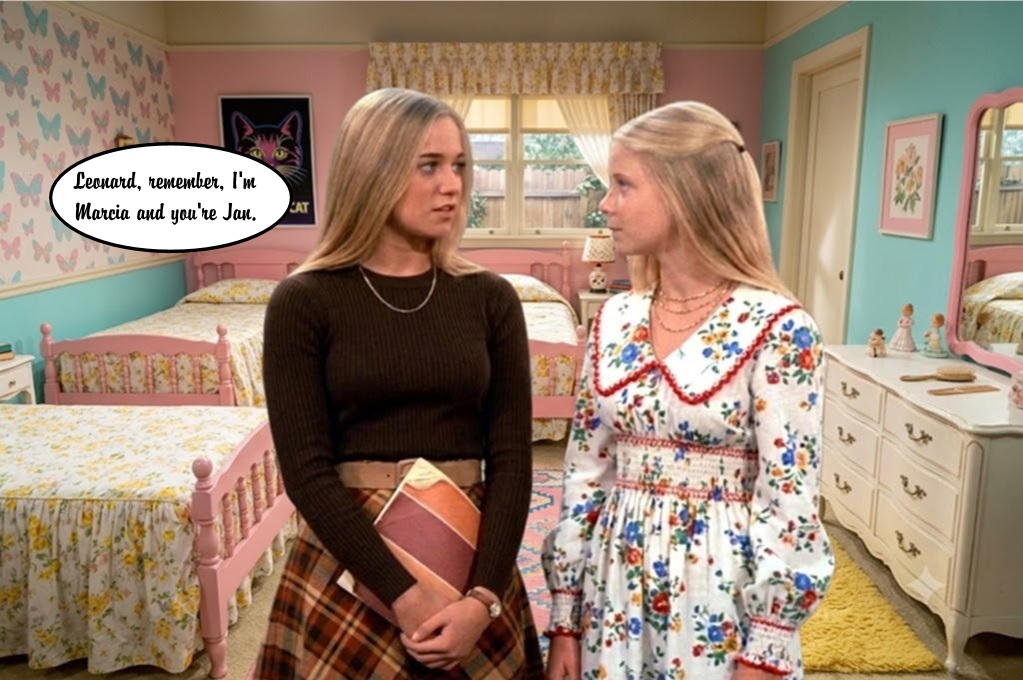
Chapter 1
It began, as most of Sheldon’s disasters did, with a whiteboard, three months of sleep deprivation, and Leonard’s reluctant signature on a waiver that said, in very small print, *I understand this may involve irreversible chronological displacement and/or gender-adjacent corporeal occupancy.*
The machine hummed. Reality hiccupped.
When the world stopped spinning, Sheldon found himself staring at a ceiling that was not his own. Soft pastel walls. A poster of Bobby Sherman. The unmistakable scent of Aqua Net and lemon furniture polish. He sat up-and immediately noticed two highly distressing data points:
1. His center of gravity had shifted in a manner inconsistent with his previous skeletal structure. 2. He was wearing a dark brown long-sleeved, fine-knit ribbed sweater with a rounded crew neckline, a high-waisted, knee-length flared skirt in warm plaid of brown, orange, and beige, a light brown belt cinching a waist that had never previously required cinching, a delicate silver chain necklace, and a slim watch on his right wrist.
Across the room, Leonard made a sound like a strangled cat.
Leonard was in a white long-sleeved midi dress with a colorful vintage floral print-blue, yellow, red, and green-featuring a wide scalloped bib collar with red piping above a smocked fitted elastic waist, long bishop-style sleeves with gathered cuffs edged in matching red piping, and a subtle layered gold chain necklace. His hair (hers?) was a soft, shoulder-length brown with a gentle flip.
Sheldon’s new voice emerged higher, smoother, and unsettlingly pleasant. “Leonard. We appear to have undergone a full somatic transfer into the corporeal forms of Marcia and Jan Brady, approximately 1973. I am Marcia. You are Jan. I am nineteen. You are eighteen. This is… suboptimal.”
Leonard stared at his hands, then at the floral dress, then at Sheldon. “You built a time machine that body-swaps us into *Brady Bunch* characters?”
“Technically it was a quantum chronological displacement device with an unintended anthropomorphic occupancy subroutine. Also, yes.”
A voice floated up the stairs. “Girls! Breakfast! You’re going to be late!”
They froze.
The rules of the machine (as far as Sheldon had hastily deduced while the world was still rearranging) were simple and absolute: remain undetected as impostors for one full day. At midnight, if both returned to the original temporal coordinates without discovery, the transfer would reverse. If either was exposed-or if one refused to return-the machine would lock, and they would remain.
Sheldon smoothed the skirt with practiced, elegant motions that felt disturbingly natural. “We have approximately sixteen waking hours. We will attend breakfast, school or whatever adolescent ritual this era demands, dinner, and any familial bonding activities. We will speak in period-appropriate vernacular, avoid references to string theory, and under no circumstances mention that Carol is not their biological mother in a way that suggests advanced knowledge. Agreed?”
Leonard tugged at the scalloped collar. “I look like a walking doily.”
“You look like Jan Brady. Embrace the data set.”
Breakfast was a minefield of pancakes, sibling banter, and Alice’s cheerful hovering. Sheldon-as-Marcia poured syrup with surgical precision and offered a bright, practiced smile. “These look *wonderful*, Alice.” The cadence was perfect-bright, slightly superior, the voice of a girl who knew she was the golden one.
Leonard-as-Jan mostly pushed eggs around the plate and muttered “Thanks” whenever spoken to. When Cindy asked why Jan was being so quiet, Leonard managed, “Just… thinking about… stuff.” It was almost plausible.
School (or the 1970s equivalent of a high-school day that somehow still involved pep rallies and lockers that smelled of stale gum) was worse. Sheldon navigated the social hierarchy of Marcia Brady with terrifying competence-smiling at the right boys, deflecting compliments with modest demurrals, correcting a history teacher’s minor error about the Suez Crisis in a way that somehow still earned an approving nod. Leonard spent most of the day trying not to trip over the hem of the midi dress and failing to remember which of Jan’s friends was named something that sounded like “a vegetable.”
By afternoon they were home again. Greg was practicing guitar. Peter was arguing with Bobby about a baseball. Alice was humming in the kitchen. Carol and Mike were discussing something about a PTA meeting in low, parental tones.
Sheldon stood in front of the mirror in Marcia’s room, turning slowly. The sweater clung in soft, precise ribs. The plaid skirt flared when he moved. The silver chain rested cool against collarbones that were not his. He lifted a hand and watched the watch glint.
“I have been Marcia Brady for eleven hours and forty-three minutes,” he said quietly. “My resting heart rate is lower. People smile when I enter rooms. No one has asked me to recalibrate their router or explain why I am wearing the same pants for the third consecutive day. There is… order here. Aesthetic order. Social order. A predictable narrative structure.”
Leonard, still in the floral dress, sat on the edge of the bed. “Sheldon. We’re going home at midnight.”
Sheldon met his eyes in the mirror. “I don’t want to.”
The words landed like a dropped beaker.
“I like this,” Sheldon continued, almost clinical. “I like being tall in this specific way. I like the way fabric moves. I like that when I speak, people listen because I am Marcia, not because I have threatened them with a fire extinguisher. Leonard… I do not wish to return.”
Leonard stood. The bishop sleeves swayed. “You can’t stay. The machine requires both of us. If you don’t come back, neither of us does. I’ll be stuck as Jan Brady forever. I will have to live through the entire 1970s. There is no Wi-Fi. There is no *soft serve* the way we know it. There is *Greg*.”
Sheldon’s expression flickered-something almost like grief, quickly buried under logic. “Then we have a classic prisoner’s dilemma with temporal stakes. If I remain and you attempt to return alone, the system fails and we both remain. If you stay against your will, you will resent me. If I leave against mine, I will resent the universe.”
Silence stretched between them, filled with the distant sound of Alice calling everyone for dinner.
Leonard exhaled. “We finish the day. We don’t get caught. At midnight we stand in the same spots we arrived in. And then… we decide. Together.”
Sheldon looked at his reflection one last time-the sweater, the plaid, the silver chain, the quiet, competent face of a girl who had never needed to prove she was the smartest person in the room because the room already assumed it.
“Very well,” he said. “One more family dinner. One more evening of Brady chaos. And then we will see which version of reality is more… livable.”
They walked downstairs side by side-Marcia in brown and orange plaid, Jan in white floral with red piping-two physicists wearing the faces of the 1970s, carrying a secret that had to last until the clock struck twelve.
Outside, the California evening was soft and gold. Inside, the Brady family was already arguing cheerfully about whose turn it was to set the table.
Midnight was still hours away.
And Sheldon Cooper, for the first time in either life, was not entirely sure which direction he wanted time to run.
Chapter 2
They retreated to Marcia’s room after dinner, the door closed against the Brady chaos downstairs. Leonard perched on the edge of the bed in the floral midi dress, still tugging absently at the red-piped cuffs. Sheldon stood at the vanity, adjusting the silver chain at his throat with precise fingers.
Leonard watched him for a long moment. “Okay. Serious question. What do you actually *know* about being a woman?”
Sheldon paused, considering. “Empirically? Very little. My prior data set was limited to observational anthropology, a few documentaries, and the occasional peer-reviewed paper on secondary sexual characteristics. Practically?” He turned, the brown ribbed sweater soft against the warm plaid skirt. “I don’t know. But I like it anyway.”
Leonard’s eyebrows rose.
“I like how boys look at me,” Sheldon continued, almost conversational. “There’s a measurable shift in pupil dilation, posture, vocal pitch. It’s… affirming in a way that peer-reviewed praise never was. And for the first time in either of my lives, I can look at a boy and think-objectively, subjectively-he is cute. The neural pathways that previously only activated for theoretical physics or a perfectly calibrated cup of tea are now firing for jawlines and collarbones and the way certain young men push their hair back.”
He gestured at his own reflection, then at Leonard. “Also, coordinating an outfit requires far more complex calculations than calculus. You’re dealing with multivariable systems: ambient temperature and humidity, expected duration of exposure, social context of the destination, hierarchical status of companions, probability of encountering additional variables-potential romantic interests, rivals, authority figures-plus contingency planning. What accessories to carry in case conditions change mid-event. A cardigan for temperature drop. A different necklace if lighting shifts. Lip color that survives both conversation and possible kinetic contact. The combinatorial explosion is extraordinary. In fact, if we assign weighted values to each factor-”
“You like men?” Leonard cut in, voice cracking slightly higher than Jan’s usual register.
Sheldon’s eyes widened, then narrowed with the pure, unfiltered delight of a new data point locking into place. “I DO NOW!”
The phone on the nightstand rang-a sharp, analog trill that made them both jump. Leonard reached for it automatically, then froze when a deep, friendly college-boy voice came through the receiver.
“Jan? Hey, it’s Mike… from the party last week? I know this is kind of last-minute, but I was wondering if you wanted to grab a burger and maybe catch that new movie tonight. Around seven?”