
Good Morning Lucy
Part 1
Lloyd had built his fortune the old-fashioned way: long hours, sharper instincts than most, and a talent for knowing when to walk away. By forty-two he had sold the last of his companies, liquidated the stock options, and watched the final wire transfer land. The number was large enough that interest alone would keep him comfortable for several lifetimes. He had no remaining partners, no board, no obligations that could not be quietly dissolved. For the first time in his adult life, the only person he needed to please was himself.
What he wanted was not another yacht or a private island. He wanted to stop being an adult.
He wanted to live as Lucy.
The decision had been forming for years in the quiet corners of his mind, gathering detail the way a child gathers toys. Once the money was secure, he began the work of making that fantasy permanent. He approached the project with the same methodical care he had once used to acquire companies. Nothing would be left to chance. Once he stepped into the role, he intended never to step out again.
The first and most visible change was the room.
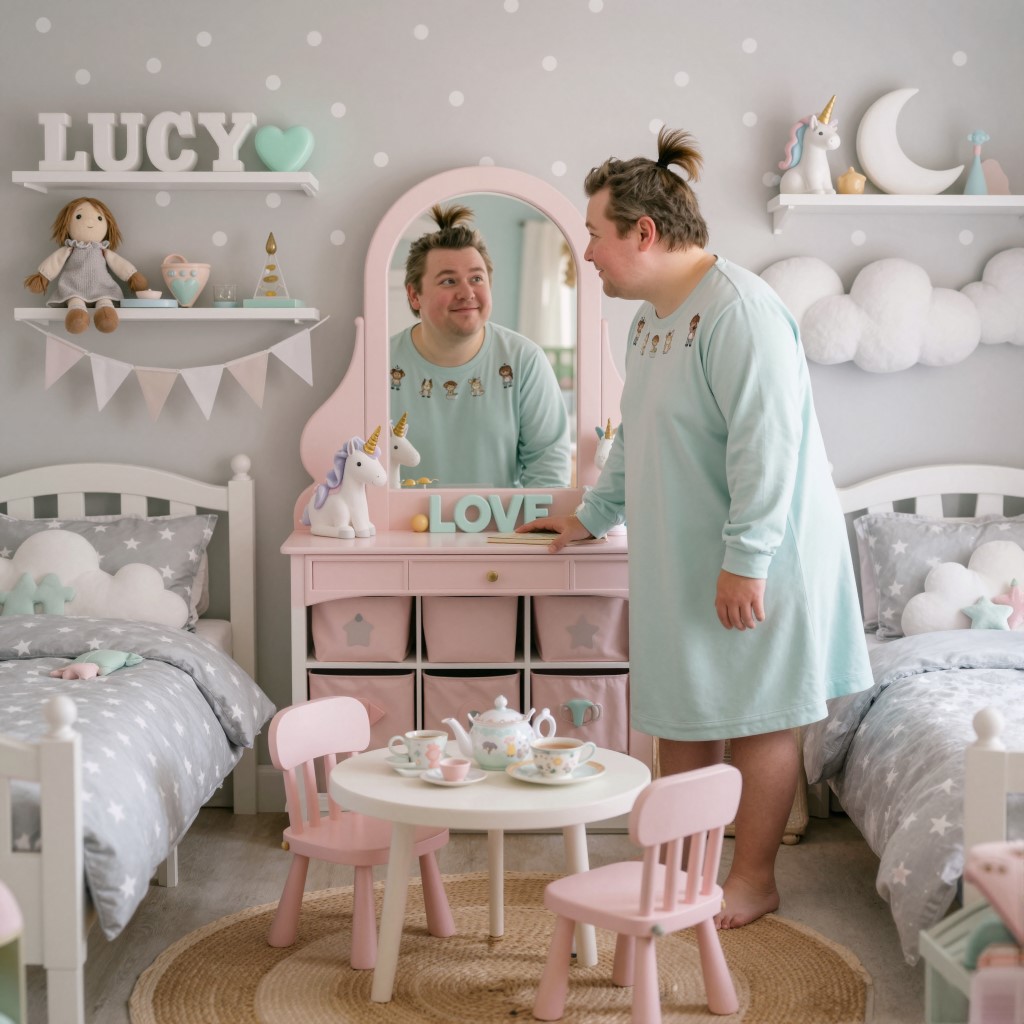
He bought a large, sun-filled unit on a high floor of a quiet residential building and had the entire place gutted. Every adult trace disappeared. The walls were painted a soft dove gray scattered with white polka dots. A low white bookshelf was installed along one wall, its cubbies filled with pink and lavender storage bins. Above it he mounted a white shelf that held a rag doll with yarn hair, a pink unicorn, a small tea set, and a row of wooden letters that spelled LUCY in pale blue and pink. A mint-green heart light and a crescent-moon nightlight flanked the name. Framed rabbit illustrations and cloud mobiles completed the walls. Two toddler beds with white frames and soft gray star-patterned bedding faced each other across a thick, pale carpet. A small round white table and two pink chairs sat in the center of a pink circular rug, ready for tea parties. A pink vanity with an oval mirror stood against the opposite wall, its surface already holding a few board books and a soft hairbrush.
Lloyd spent weeks sourcing every object himself. He rejected anything that looked temporary or “play.” The furniture had to be solid, the finishes durable, the scale consistent with a room meant for a child of two or three who would never outgrow it. He measured the height of the beds against his own body so that climbing in and out would feel natural once he was living at that scale. He tested the softness of every blanket. He ordered extra sets of the star sheets and the cloud-shaped pillows so that laundry never forced a return to ordinary bedding.
Clothing came next, and it required more planning than most people would ever guess.
He commissioned an entire wardrobe in adult sizes cut to toddler silhouettes: long pink nightgowns with ruffled hems and cartoon graphics of smiling girls and kittens, the words “A-meow-zing!” printed beneath a rainbow. Soft cotton day dresses with puffed sleeves. Overalls with appliquéd animals. Socks with lace trim. Soft shoes that looked like little sneakers but were sized for his feet. Everything was chosen in pastels-pink, lavender, mint, pale yellow. He ordered multiples of each piece so that the laundry rotation would never force him into anything that broke the aesthetic.
The most carefully considered items were the pull-ups.
He researched brands that made absorbent training pants in adult sizes and ordered them by the case-hundreds of them. He tested different styles for fit, for noise, for how they felt when he walked and sat and lay down. He wanted the soft rustle and the padded bulk to become ordinary, not a costume. Storage was arranged in the pink bins on the low shelves and in the drawers of the vanity so that changing was never an inconvenience. A small changing pad was kept ready on a low table. He practiced the sequence until the motions felt automatic: the slight lift of hips, the peel of the tabs, the clean replacement, the soft pat to settle the new one in place.
Nannies were the final structural piece.
Lloyd interviewed carefully. He needed women who understood that the arrangement was not temporary role-play and not a medical situation to be managed toward recovery. He wanted caregivers who would treat him, consistently and without irony, as a toddler named Lucy. After several months he settled on three experienced nannies. The schedule was designed for continuity without burnout: each woman worked three consecutive twenty-four-hour shifts, then had six days completely free. The rotation never left him alone. One nanny was always present-feeding him, changing him, dressing him, reading to him, supervising play, putting him down for naps, bathing him in the evening, and settling him into bed with a story and a nightlight.
Contracts were drawn by a discreet attorney. The nannies were paid generously and bound by strict confidentiality. Their duties were written in plain language: Lucy was to be spoken to in simple sentences. Decisions about clothing, meals, and activities belonged to the nanny on duty. Adult conversation was discouraged in Lucy’s presence. If Lucy attempted to discuss business, money, or the past, the nanny was to redirect gently but firmly-perhaps with a storybook or a suggestion of tea party. The contracts also covered medical proxies and emergency contacts so that, should anything happen, the caregivers had clear authority to act in Lucy’s interest without involving outside adults who might try to “restore” him.
Food and routine received the same attention.
Lloyd stocked the kitchen with soft foods, purees, and simple finger foods that could be served in divided plastic plates. Sippy cups and small bowls with suction bases. A high chair was installed, adjusted to his adult frame so that mealtimes felt secure and contained. The daily schedule was posted on the refrigerator in large, cheerful letters: wake-up, breakfast, play, morning snack, quiet time, lunch, nap, afternoon play, dinner, bath, story, bed. The nannies were instructed to keep the rhythm steady. Variation was allowed only within the toddler framework-extra time with the tea set, a longer story, a special outing to the park if weather permitted-but the structure itself was not to be broken.
He thought about the body as well.