In Reverse
Chapter 1
Jennifer Merritt had always known who she was.
The invitation to her cousin’s engagement party arrived on thick cream cardstock, the kind her family still preferred over group texts. She chose her outfit with care the night before: a white lace-trimmed V-neck blouse with soft puffed sleeves that gathered just enough to feel romantic without being costume-y, paired with a high-waisted, structured light gray plaid pencil skirt that hugged her waist and flared just slightly over the hips. A narrow pink belt with a gold buckle cinched the silhouette into a clean hourglass. Pearl earrings and a matching strand of pearls at her throat completed the look. Vintage elegance with a quiet playful accent. She felt pretty in it. She felt like herself.
The house smelled of roast and expensive candles when she arrived. Her mother was the first to notice.
“That’s a lovely blouse, Jennifer,” she said, leaning in for the usual cheek kiss. “Very… feminine.”
Jennifer smiled. “Thank you. I thought it suited the occasion.”
An aunt appeared next, eyes traveling from the puffed sleeves to the pencil skirt. “Is that new? It looks expensive.” A cousin’s husband murmured something about how “put together” she looked. The comments stayed light for the first twenty minutes. Then the tone shifted.
Her uncle, the one who still told the same stories from twenty years ago, tilted his head. “Why are you dressed like that?”
Jennifer laughed, assuming it was a clumsy compliment. “Like what?”
“Like a woman,” he said, not unkindly, but as if stating a weather report.
The living room seemed to quiet by degrees. Her mother set down her wineglass. A younger cousin glanced at her phone, then up again. Someone asked, almost conversationally, whether she was “transitioning.” Another voice-her own sister’s-wondered aloud if this was “a phase” or “something she needed to talk about.”
Jennifer stood very still in the middle of the room, the pearls cool against her collarbone. The questions kept coming, overlapping, circling the same impossible premise. They spoke as if she had once been someone else. As if the body she had lived in her entire life, the name on her birth certificate, the childhood photographs of a little girl in sundresses, had all been a collective misunderstanding that only they could now correct.
She tried to answer. “I’ve always been a woman. This is just… an outfit. A nice outfit.”
They looked at her with a mixture of concern and mild exasperation, the way people look at someone who is confused about something obvious. No one raised their voice. No one was cruel in any theatrical sense. They simply continued as if the conversation were reasonable. Jennifer felt the floor tilt under her feet. She smiled through the rest of the evening because that was what she had always done when the world became suddenly, inexplicably wrong. She ate a small plate of food she could not taste. She congratulated the engaged couple. She left early, citing a headache.
That night she sat on the edge of her bed in the same clothes, staring at her reflection in the closet mirror. The lace, the plaid, the pink belt, the pearls-everything still looked like her. The face looking back still looked like hers. Yet an entire room of people who had known her since childhood had treated the fact of her womanhood as a recent and questionable development.
By Monday she had made an appointment.
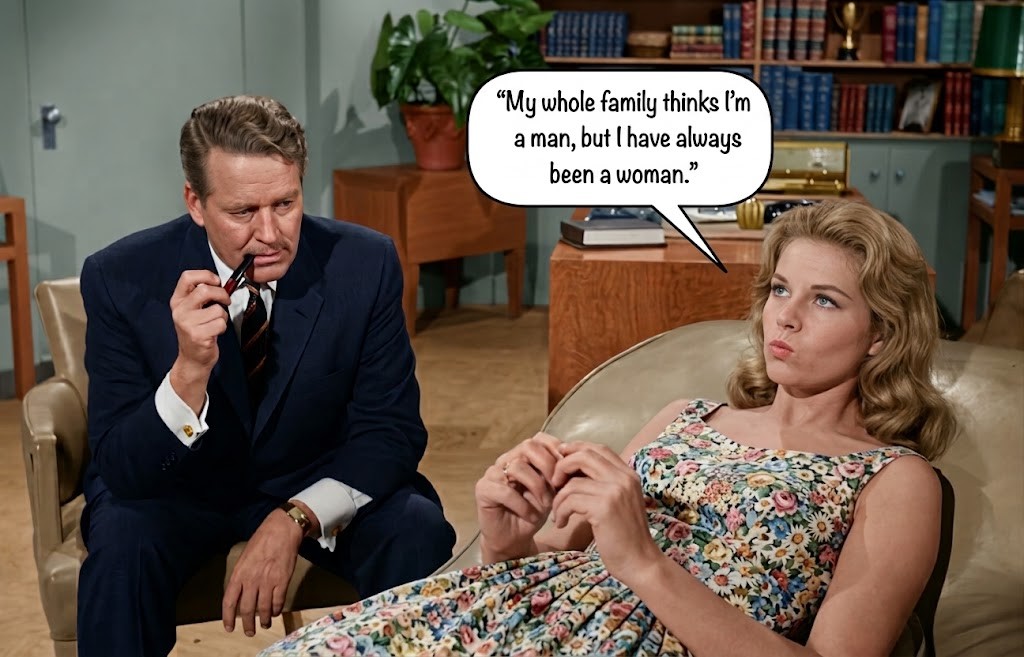
The psychiatrist’s office was quiet, lined with bookshelves and a large monstera plant in a terracotta pot. He was an older man in a navy suit, pipe in hand though unlit, the sort of careful listener who made notes without rushing. Jennifer sat on the leather chaise, hands folded in her lap, and told him everything: the invitation, the blouse, the questions that had started as compliments and ended as interrogations. How her family had looked at her as if she were playing dress-up in her own skin.
When she finished, the room was silent except for the soft tick of a clock somewhere behind her.
She met his eyes and said the only sentence that still made sense.
“My whole family thinks I’m a man, but I have always been a woman.”
Chapter 2
The psychiatrist studied her for a long moment after she finished speaking.
Jennifer sat upright on the leather chaise, hands still folded, the same quiet posture she had held throughout the session. To him she looked exactly as she had always looked to herself: a woman in her mid-thirties with soft blonde waves, clear blue eyes, and the natural curves of a feminine figure. He told her so without hesitation.
“You present as a woman,” he said. “You always have, according to every record I can see.” He opened a slim folder and flipped through a few pages-birth certificate, school transcripts, old medical notes. “Documentation confirms it. Jennifer Merritt, female, from the beginning.”
He set the folder down and regarded her over the rim of his glasses. “Is your family the sort who play elaborate jokes? Practical jokers of the cruel variety?”
“No,” she answered at once. “They’re not like that. Not at all.”
He nodded slowly, as if the answer only deepened the puzzle. “Then I don’t know why they’re treating you this way. People sometimes invent stories when they’re uncomfortable, or when they’re trying to force a narrative that isn’t there. For now, my advice is simple. Ignore them as best you can. Protect your peace until you feel stronger. You’re not the one who’s confused.”
Jennifer left the office with a strange mix of relief and residual unease. The confirmation helped. The advice felt practical. She told herself she would follow it.
A week later she confided in her closest friends over coffee at her apartment. At first they were everything friends should be-sympathetic, outraged on her behalf, full of gentle questions about how she was holding up. They listened while she described the engagement party, the pointed remarks, the way her own family had looked at her as if she were an impostor in her own life. They agreed it was bizarre. They agreed she had every right to be shaken.
Then, one ordinary Thursday evening, the tone changed.
Jennifer had invited a small group over-two women from work, a couple of college friends, and two men she had known since her twenties. She was wearing a soft cream sweater that skimmed her figure and a charcoal A-line skirt that fell just below the knee. The sweater’s neckline was modest, the fabric light enough to show the natural curve of her waist and the gentle flare of her hips. At five-foot-four she had never been tall; her frame was compact, rounded in the places that marked her as unmistakably female. She moved around the kitchen pouring wine, the pearls from the engagement party still at her ears because she liked them.
One of the women set her glass down carefully.
“Jen… we’ve been talking. And we need to ask you something.”