Since Last Accident
Charles stumbled out of the lab, the heavy wooden door swinging shut behind him with a dull thud. The building looked like any other structure on the remote mining site-weathered planks, a corrugated roof, and a faded company logo-but everyone inside knew better. It was 1956, and behind those walls they had been carefully studying the strange technology recovered from a crashed vessel that had come down in the desert two years earlier. Secrecy was everything. Distance from the public was everything.
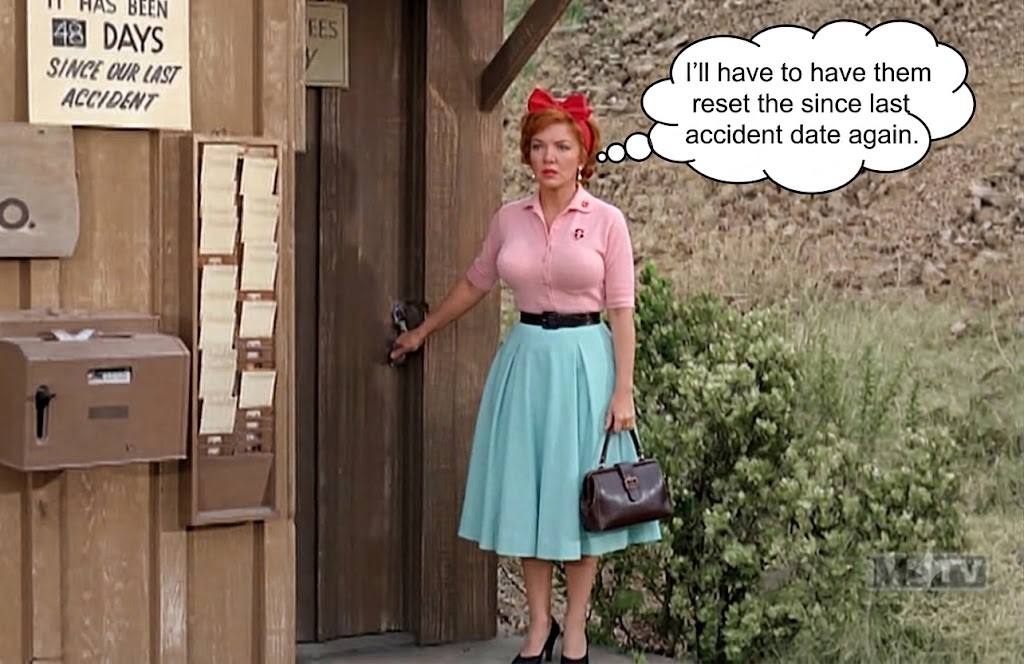
He leaned against the exterior wall for a moment, steadying himself. Beside the rack of timecards hung a painted sign, its numbers carefully updated each morning:
It has been 48 DAYS since our last accident.
Forty-eight days. Until today.
Charles looked down at himself. The body that answered him was no longer the one he had woken up in. A fitted, short-sleeved light pink polo-style shirt clung to a soft, unfamiliar chest, its pointed collar neat and its small red emblem bright against the fabric. Below it, a high-waisted, knee-length pastel blue A-line skirt with broad pleats swayed slightly with every unsteady breath. A narrow black leather belt cinched the waist. On his feet were black high-heeled pumps that forced his weight forward onto toes that no longer felt like his own. A large red bow headband sat in short, carefully styled auburn hair. Pearl drop earrings brushed against the sides of a smoother, finer jaw. In one hand he clutched a dark brown structured handbag with a top handle and buckle accent-the same bag that now held every piece of identification and every tool that still belonged to the man he had been that morning.
He was a woman.
Inside the lab they had tried to reverse it. The alien device had flared without warning during a routine calibration. No one had been standing close enough to intervene. When the light faded, Charles was gone and she remained. The medical team had checked vitals, run scans, and come up empty. The technology did not care for their theories or their panic.
When she finally managed to explain what had happened, the project directors listened in silence that stretched too long. Accidents happened. Transformations had happened before. But forty-eight days of clean records made this one harder to accept as pure chance. Eyes lingered on the pink shirt, the blue skirt, the red bow. One of them asked, carefully, whether she had perhaps been experimenting. Another suggested she go home, rest, and report back in the morning once the situation had been “reviewed.”
She went home.
She never returned.
That night, standing in front of a mirror that no longer showed the face she expected, Charles made a quiet decision. The life that had existed before the lab-the reports, the clearances, the careful distance from ordinary people-felt suddenly distant and thin. The body she inhabited was soft and complete and undeniably female. It responded to the world in ways the old one never had. And somewhere in the quiet of that first evening she realized she did not want to fight her way back to the man she had been.
She wanted something else.
She wanted a handsome man who would look at her the way men looked at women in the magazines she had never paid attention to before. She wanted a house with a kitchen that smelled of supper. She wanted to be called by a soft name, to wear dresses without explanation, to become a wife and, in time, a mother.
The identification in the handbag still carried a man’s name and a man’s photograph. Those would have to change. The past would have to be left at the edge of the mining site, along with the wooden building and the sign that would soon be reset to zero.
Charles closed the handbag, smoothed the pleats of the blue skirt, and stepped out into the warm evening air of 1956. Somewhere ahead was a different life, one she intended to claim completely.
When Charles failed to appear the next morning, the project directors grew uneasy. By the end of the week their unease had hardened into quiet alarm. The apartment she had once kept under the old name stood empty-furniture sold or discarded, lease terminated, no forwarding address left with the landlord or the post office. The careful paper trail that had once protected the lab’s secrets had simply stopped.
It took nearly two months of discreet inquiries before they located her.
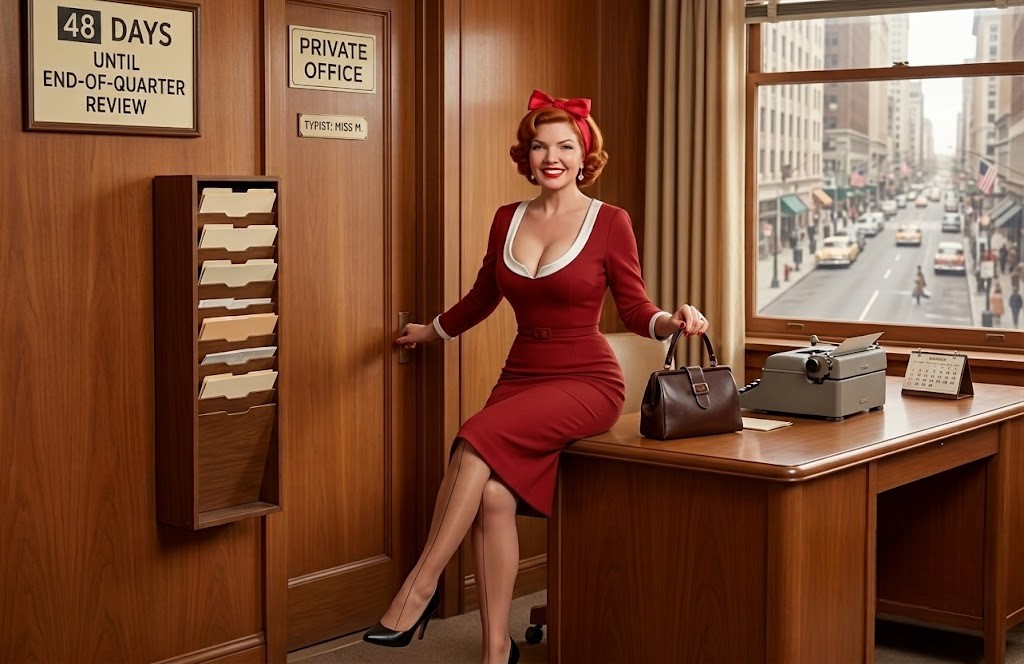
She was working as a secretary at a mid-sized law firm downtown. The name on her desk plate read Charley. She no longer answered to anything else. Every day she arrived in clothing that pushed the boundaries of what the firm’s conservative partners would tolerate: skirts a little shorter, necklines a little lower, fabrics that clung rather than merely covered. She dated almost every unmarried man in the office and more than a few of the single clients who came through the door. Her goal was simple and openly admitted to anyone who asked-find a husband, quit, and leave the working world behind for good.
The day the former directors finally walked into the reception area, Charley was seated behind her desk in a provocative red U-neck dress with crisp white trim. The color made her auburn hair brighter, and the neckline drew every eye in the room. When she looked up and recognized them, her voice rose into a higher, softer register than necessary.
“May I help you, gentlemen?”
They asked to speak with her privately. She led them to a small conference room, still holding the dark brown handbag that had once belonged to Charles. They spoke carefully at first-about the project, about the technology, about the life she had abandoned. They wanted her to come back, to resume the work, to let the medical team try again. They spoke of duty and of the knowledge only she still carried.
Charley listened with a polite, distant smile.