
The Turncoat
I never meant to become the very thing I set out to protest.
My name is Daniel Vance, and in the summer of 1974, I was a steward with Trans-American Airways, one of the few men willing to endure what the women around me had been enduring for years. I told myself I was an ally, a spy in enemy territory, gathering ammunition for a fight I believed in. But somewhere between the fasten seatbelt sign and the cocktail cart, the enemy became home, and the uniform became armor I never wanted to remove.
---
The decision began, as most transformative decisions do, with an injustice I could no longer ignore.
It was June when Margaret Chen approached me in the crew quarters at LaGuardia, her eyes red-rimmed and her hands trembling. She had been with Trans-American for seven years-seven years of memorizing safety procedures, of smiling through passenger abuse, of maintaining what management called "the Trans-American image." They had just suspended her for refusing to wear the new foundation garments they had introduced that spring.
"They said my uniform wasn't properly fitted," she said, her voice cracking. "They told me I needed to wear the new girdle, the one with the heavier control panel. They measured me in front of everyone, Daniel. In front of the men from management. Like I was merchandise."
I remembered watching her walk past the mirror in the dressing room afterward, watching her try to compose herself, watching her straighten the lapels of her blue dress as if the gesture could restore some measure of dignity that had been stripped away.
That night, I couldn't sleep. I lay in my apartment in Jackson Heights, staring at the water-stained ceiling, thinking about what it meant to be an ally. I had joined the union's grievance committee. I had testified before the EEOC. I had march on Washington with signs that read "DIGNITY IN THE AISLES." But I had never truly understood what it meant to wear their burden.
The thought came slowly at first, then with sudden clarity: What if I wore it?
---
The uniform components arrived in a discreet brown paper package, purchased from a shop in the garment district that specialized in hard-to-find sizes. The saleswoman, a sharp-eyed woman named Rosa who had clearly seen every variation of human desperation pass through her door, never questioned my request. She simply measured me, nodded, and produced exactly what I needed.
The bra was the first item I examined-white, properly structured, with boning that promised both shape and constraint. It felt strange against my chest, this expectation of curves where none existed, this architectural requirement for softness. But there was something else there too, something I hadn't anticipated: the physical sensation of being held in, of having my body shaped into a silhouette that existed only in someone else's imagination of how a person should look.
The girdle was more demanding. It was the model the airline had recently mandated-high-waisted, with reinforced panels that compressed and lifted, that turned the wearer into a carefully engineered outline. I had seen the women struggle with these garments in the cramped bathroom stalls of airport terminals, had watched them suck in their breath and contort themselves into positions that looked almost painful. Now I understood why.
It took me nearly twenty minutes to properly situate the girdle, to roll and shimmy and adjust until it sat where it was supposed to sit. When I finally looked in the mirror, I saw a figure that was neither the man I had been nor the woman the airline wanted me to be. I saw something in between, something that existed only in the tension between what was demanded and what was endured.
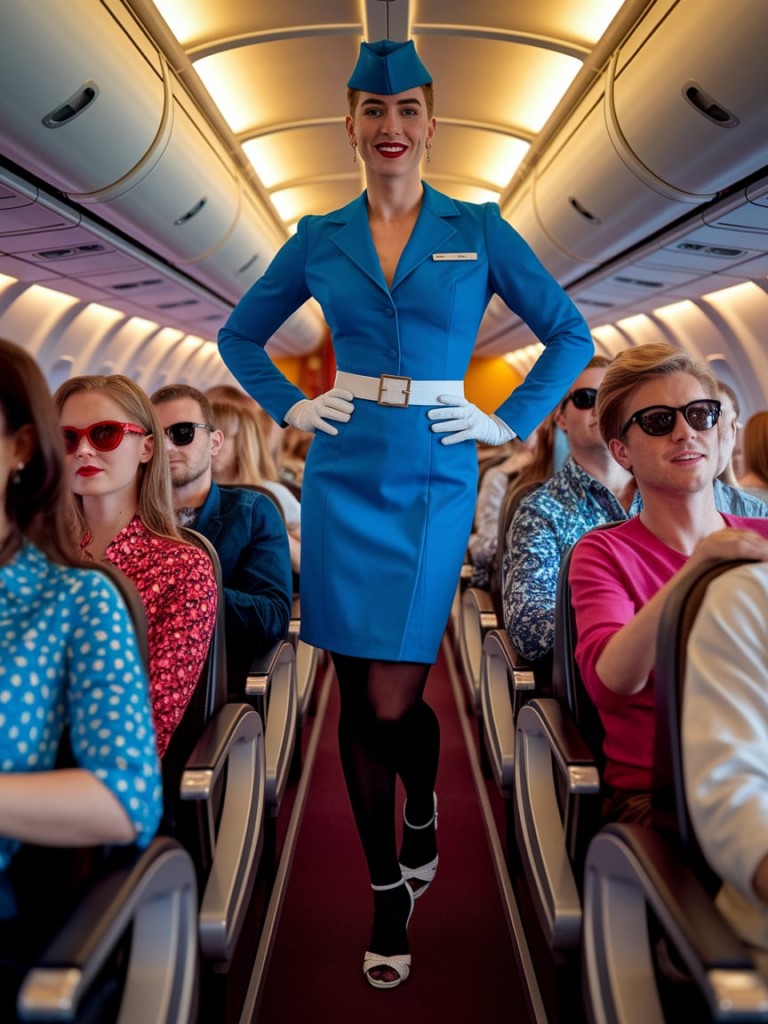
I put on the dress next-sleek blue, tailored to fall just above the knee, designed to move with the body it encased. The white belt cinched my waist, creating an hourglass shape that required constant attention, a reminder with every breath that I was now subject to the same geometry as every other stewardess on every flight I worked. The black tights were smooth against my newly hairless legs (I had shaved carefully, meticulously, as if preparation could somehow make me worthy of the costume I was donning). The high-heeled sandals-two inches, elegant, with a modest strap across the instep-altered my posture immediately, lifting me onto a new plane of existence where I moved differently, breathed differently, occupied space differently.
The gloves were the final touch. White, reaching to just above the wrist, they transformed my hands into something ceremonial, something that performed service rather than simply performed tasks. I had seen the women adjust their gloves a hundred times during a flight, had watched the ritual of straightening and smoothing as if the gloves were both uniform and armor. Now my own hands bore the same white casing, the same reminder that what you touched was as important as what you did.
I stood before the mirror for a long time.
The face required attention too. I had never worn makeup before-not really, not with intention. The powder was light but transformative, smoothing the texture of my skin into something that caught the light differently, something that seemed to belong to a different person. The eyeshadow was subtle, a soft beige that the airline permitted, that fell somewhere between natural and enhanced. I applied it carefully, learning the curve of my eyelid, the way the color could accentuate or subdue. Lipstick followed-clear red, carefully contained within the lines I had drawn with a pencil that seemed to promise precision and control. The earrings were small gold studs, just visible beneath the sweep of my hair, modest enough to pass inspection but present enough to make a statement.
I did not recognize myself.
But more importantly, I did not reject myself.
---
The first flight in full uniform was to Chicago, a routine hop that should have taken just under three hours. I had informed the airline of my intentions through proper channels-had sent a letter to personnel explaining that I would be wearing the complete stewardess uniform, including all mandated undergarments, in solidarity with my female colleagues who had been disciplined for "uniform infractions." I had not waited for permission. I had not asked for approval. I had simply declared my intention and let the consequences follow.
The response was everything I had expected and nothing I had anticipated.
Flight Attendant Coordinator Patricia Walsh intercepted me in the terminal before boarding. She was a sturdy woman in her fifties, with graying hair pulled back in a severe bun and eyes that had seen every form of rebellion and compliance in her thirty years with the airline. She looked me up and down, taking in the blue dress, the white belt, the way my heels had altered the very architecture of my spine.