
Transforination Hospital
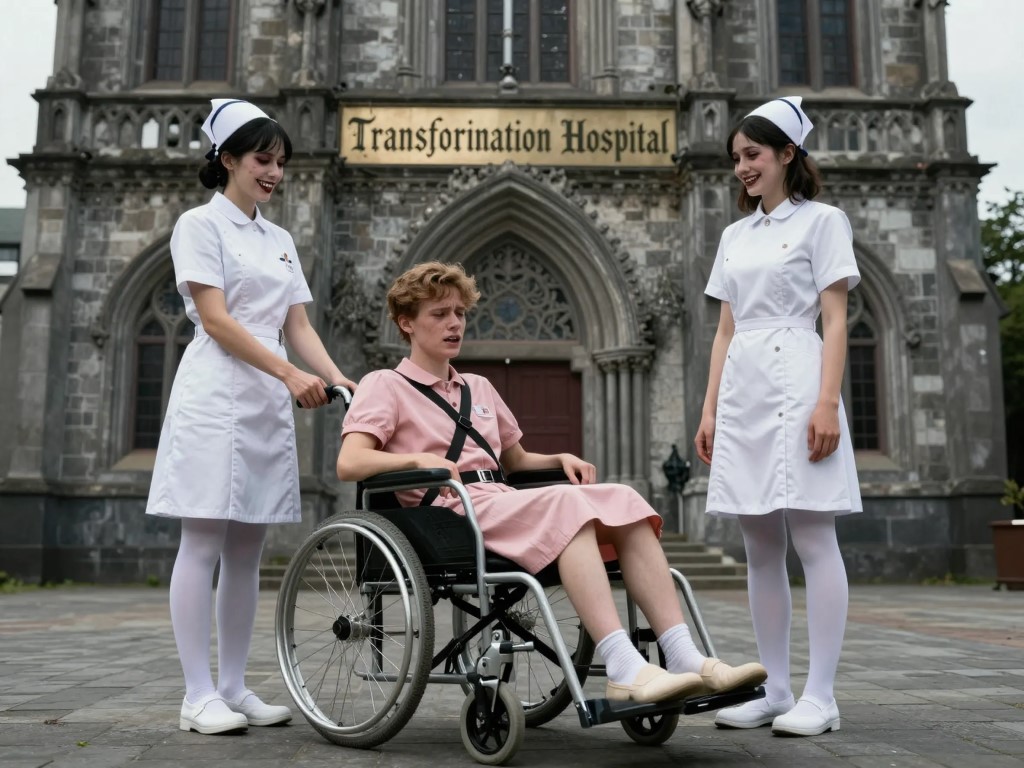
Timothy barely remembered the drive through the hills.
He remembered the gray sky hanging low over the countryside. He remembered bare trees clawing at the clouds. Mostly, though, he remembered the pain.
It lived in his joints, in his stomach, behind his eyes. Every doctor he had seen had offered a different answer. Infection. Hormones. Neurological disorder. Stress. None of the medications helped. His body had become weak so quickly that walking felt impossible. By the time the ambulance reached the old hospital grounds, he could no longer stand at all.
The building waiting for him looked less like a hospital and more like a castle abandoned by time.
Dark stone towers rose against the clouds. Narrow windows stared down like watchful eyes. Iron gates opened with a groan as the ambulance rolled through.
Above the entrance, weathered letters read:
TRANSFORINATION HOSPITAL
Timothy squinted at the strange spelling, but another wave of pain distracted him before he could think much about it.
Their uniforms unsettled him immediately.
The women wore crisp white nursing dresses with puffed sleeves and fitted waists. Their white tights were immaculate, disappearing into thick-soled white shoes that clicked sharply against the stone path. They looked less like modern nurses and more like figures from an old photograph.
“You’ll be safe here, Timothy,” one of them said warmly.
Her lipstick was pale pink. Her smile never quite reached her eyes.
They unfastened the gurney straps and transferred him into a wheelchair with surprising gentleness.
Timothy looked down at himself.
“I… I think somebody gave me the wrong gown.”
The younger nurse adjusted the blanket over his lap.
“No mistake,” she said.
“But this isn’t-”
He stopped.
The garment was technically a hospital gown, he supposed. It simply didn’t resemble any hospital gown he had ever seen. Instead of shapeless blue fabric, it was soft coral-colored material with short sleeves and a flared skirt that reached his knees.
A skater dress.
His cheeks burned.
And the socks-
They were tiny white anklets trimmed with lace.
The slippers waiting on the footrests looked unmistakably like ballet flats.
“I don’t want to wear this,” he muttered.
“You need specialized support garments for your treatment,” the older nurse explained. “Your condition affects developmental equilibrium.”
Timothy had no idea what that meant.
The nurses wheeled him through massive wooden doors and into the castle.
Inside, the hospital was strangely quiet.
No intercoms.
No televisions.
Only the soft squeak of wheels over polished floors and the distant chiming of clocks hidden somewhere deep in the stone corridors.
Portraits lined the walls. Most depicted stern-looking women in old-fashioned clothing. A few wore nurses’ uniforms nearly identical to the ones around him.
Timothy noticed something else.
Every patient he passed was female.
Some were elderly women knitting beside windows.
Some were middle-aged women reading quietly.
Some looked younger.
But all of them wore variations of soft pastel “hospital gowns” that looked suspiciously like ordinary dresses.
The nurses brought him to a private room high in one of the towers.
Rain finally began tapping lightly against the narrow window.
“Treatment begins tonight,” the younger nurse told him.
“What treatment?”
She smiled again.
“Transformation therapy.”
The first week blurred together.